News
The slow work of shaping light
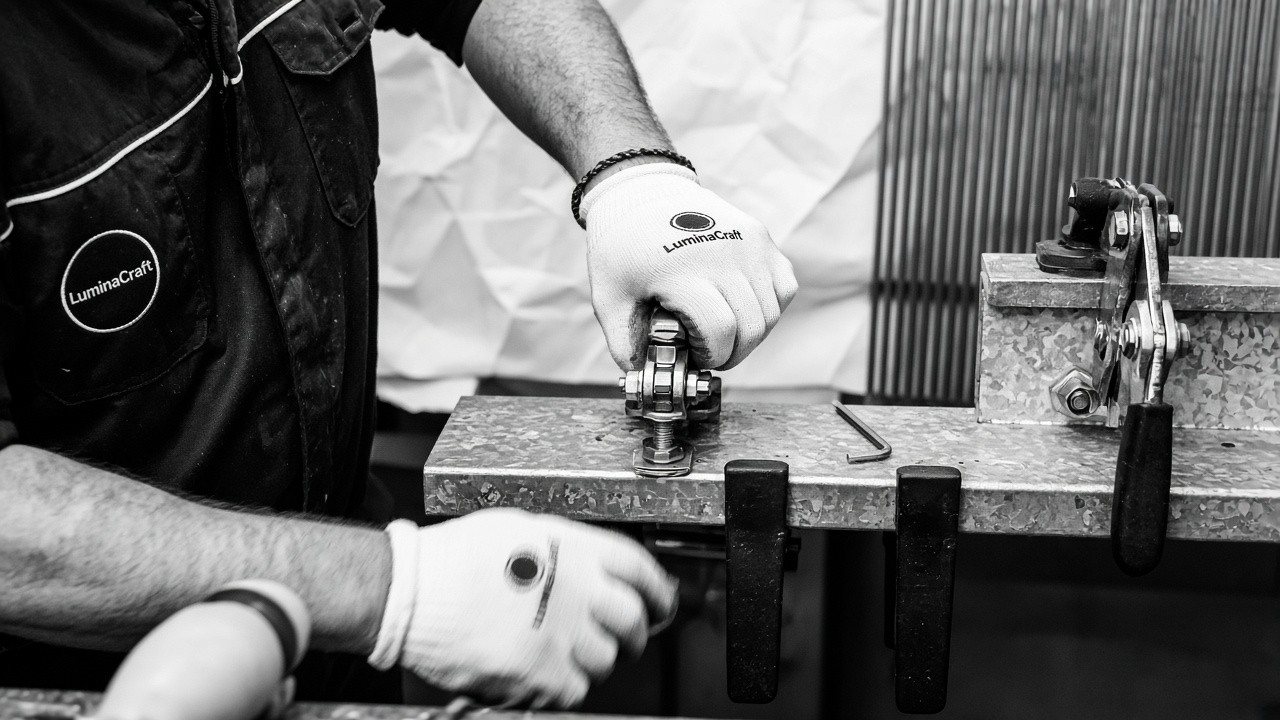
On the fifteenth of September we opened a door in our Beijing studio that we usually keep shut. Behind it: seven benches, the materials we work in, and the whole slow sequence that turns a sheet of brass, a lump of glass and a length of copper wire into a lamp that holds light the way we want it held. We had never shown that sequence complete before. For six weeks we are showing it every day, from nine in the morning until six.
Seven benches, one long sequence
Visitors come in at the beginning and follow a piece to the end. It arrives as flat metal and leaves the room signed on the underside. Between those two moments sit the steps we normally hide:
- Cutting and beating, where the form is decided by eye.
- Welding, grinding and brushing — the invisible work, and the surface that shows it.
- Paint, mixed at the bench and rested between thin coats.
- Blown glass, turned against the light and checked for roundness.
- Wiring, tested twice, the second test by someone who did not do the first.
- The signature, then an hour in the dark before a lamp is allowed to leave.
None of it is fast, and we have stopped apologising for that. A shade can take two days at the beating bench and three more under the paint. When the light comes out wrong the piece goes back to the bench it came from. Since our founding we have kept room for that: a spare bench, a day permitted to pass with nothing finished on it. The pace is the method. A surface that light behaves on cannot be hurried into being.
What people asked us
The questions were rarely about wattage. A lighting designer stood at the brushing bench for forty minutes and then asked whether the grain runs the same way on every piece. It does not. She said she had hoped it would not. An architect asked how long we would keep the room open, and we told her: as long as the benches have work on them. One afternoon a visitor carried in a lamp of ours he has lived with for eleven years and set it on the counter, so that the person who painted it could look at it again under our own light. “The hand remembers a form before the drawing does,” she said. “I am only keeping it in practice.”
We will keep the room open through the autumn. Come in the morning for the metal; come near six, when the daylight goes, for what the finished lamps do on their own. There is no programme and nothing to buy at the end of it. Only the benches, and the slow work of persuading light to stay.